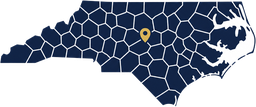
Why Wake County passed Mecklenburg
For most of the 20th century, Mecklenburg County (Charlotte) was the most populous county in North Carolina — anchored by banking, manufacturing, and the state's busiest airport. Wake County (Raleigh) caught up in the 2010s and pulled ahead during the pandemic-era reshuffle of U.S. white-collar work. Today both counties exceed one million residents, the first in NC history to do so, and they alternate the lead in monthly Census estimates by a few thousand people.
The two counties together hold roughly a fifth of all North Carolinians — a striking concentration in a state of 100 counties.
Inside the top 10 largest NC counties
Eight of the ten largest counties sit in the Piedmont, the central urban band of the state: Wake, Mecklenburg, Guilford (Greensboro), Forsyth (Winston-Salem), Cumberland (Fayetteville), Durham, Union, and Cabarrus. The two outliers are Buncombe in the Mountains (Asheville) and New Hanover on the coast (Wilmington) — both regional economic centers that punch well above their geographic footprint.
Together these ten counties contain roughly 46% of North Carolina's residents, even though they cover less than a fifth of the state's land area.
Largest North Carolina counties by land area
Population and land area diverge sharply in NC. By area, the leaders are Robeson (~949 sq mi), Sampson (~945), and Columbus (~937) — all rural counties in the southeastern Coastal Plain. None crack the top 25 by population. The smallest county by area, Chowan, is just ~173 sq mi, more than five times smaller than Robeson.
Where growth is happening
Within the top 25, the fastest growers since the last decennial census are the ring counties around Raleigh-Durham and Charlotte: Johnston, Cabarrus, Union, and Brunswick (Wilmington's bedroom county). Each has added tens of thousands of residents as home-builders push out from saturated urban cores. The slowest large-county growers are Cumberland and Pitt, both anchored by older institutions (Fort Liberty and East Carolina University) rather than tech-driven in-migration.
For the opposite end of the spectrum, see our smallest North Carolina counties ranking, or the full 100-county population list.