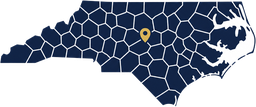
How North Carolina's population is distributed
North Carolina's population is unusually concentrated for a state of its physical size. The ten largest counties — almost all in the Piedmont urban crescent from Charlotte through the Triad to the Triangle — contain roughly 46% of all residents, while the smallest 25 counties combined account for less than 7%. The median county has only about 52,082 residents, far below the state average of about 104,409 per county.
This concentration is a relatively modern story. As late as 1950, only Mecklenburg and Guilford counties exceeded 200,000 people; today, sixteen do.
Population density
The densest county in North Carolina is Mecklenburg, at roughly 2,121 residents per square mile — a function of its compact footprint as much as its raw population. Mecklenburg, Durham, and Forsyth follow. Outside the urban band, density drops sharply: the median NC county has fewer than 150 residents per square mile, and the least-dense counties in the Mountains and northeastern Coastal Plain fall below 30.
Growth patterns
Three patterns dominate recent growth:
- Suburban ring growth around Charlotte (Union, Cabarrus, Iredell), Raleigh-Durham (Johnston, Chatham, Franklin), and the Triad (Davidson, Randolph).
- Coastal growth in Brunswick, New Hanover, Pender, Dare, and Currituck — driven by retirement migration and remote-work relocations.
- Mountain plateau in Buncombe, Henderson, Haywood — slower than the urban crescent but steadily positive.
Rural Coastal Plain counties (Bertie, Halifax, Northampton, Edgecombe, Tyrrell) have continued to lose population over the same period.
Data & sources
Population figures come from the U.S. Census Bureau, latest official data — Decennial Census Table P1 supplemented by Vintage population estimates for counties. Boundaries and land area come from Census cartographic boundary files, cross-checked against NC OneMap. We round all figures to the nearest whole person and the nearest square mile. See our full methodology.